Observability and webhooks
Prometheus metrics, OpenTelemetry traces, and signed, retried webhooks for audit events.
Three ways to watch an instance from outside it. None carries conversation content: no prompts, replies, tool inputs or results, file names or request bodies.
| Turned on by | Shown on | |
|---|---|---|
| Metrics | METRICS_TOKEN (environment) | System health → Observability (read-only) |
| Traces | OTEL_EXPORTER_OTLP_ENDPOINT (environment) | System health → Observability (read-only) |
| Webhooks | Tools & integrations → Webhooks | The Webhooks page and System health |
Metrics
Set METRICS_TOKEN (at least 16 characters, for example openssl rand -hex 24) and restart the API. It then serves Prometheus text format at /metrics on the API port, requiring the token as a Bearer credential. Without it, /metrics answers 404.
/metrics is at the API's root, not under /api, so the bundled web proxy does not forward it: scrape each API replica directly, from inside your network. Values are per process.
scrape_configs:
  - job_name: oci-api
    authorization:
      type: Bearer
      credentials_file: /etc/prometheus/oci-metrics-token
    static_configs:
- targets: ['api-1:3000', 'api-2:3000']| Metric | Type | Labels |
|---|---|---|
oci_http_requests_total | counter | method, route (the route template), status |
oci_http_request_duration_seconds | histogram | method, route |
oci_chat_replies_total | counter | status: complete, error, cancelled |
oci_chat_reply_duration_seconds | histogram | status |
oci_tool_calls_total | counter | tool, outcome: ok, error, denied, refused |
oci_tool_call_duration_seconds | histogram | tool |
oci_job_runs_total | counter | job, outcome: success, error |
oci_job_duration_seconds | histogram | job |
oci_web_searches_total | counter | provider (such as searxng, brave), slot: primary, fallback; outcome: answered, failed. Searches from conversations only, never the query |
oci_web_search_duration_seconds | histogram | provider, slot (retry included) |
oci_webhook_deliveries_total | counter | outcome: succeeded, retrying, failed |
oci_webhook_deliveries_pending | gauge | |
oci_storage_deletions_pending | gauge | |
oci_backup_runs_total | counter | outcome: succeeded, failed |
oci_backup_duration_seconds | histogram | |
oci_backup_last_success_timestamp_seconds | gauge | Absent until a backup succeeds |
oci_errors_total | counter | source |
oci_build_info | gauge | version |
process_resident_memory_bytes, nodejs_heap_used_bytes, process_uptime_seconds | gauge |
Labels never hold user IDs, conversation IDs or raw paths. Gauges read from the database at scrape time and are left out of a scrape if it does not answer. Useful alerts:
- alert: OciBackupStale
  expr: time() - max(oci_backup_last_success_timestamp_seconds) > 26 * 3600
- alert: OciReplyErrors
  expr: sum(rate(oci_chat_replies_total{status="error"}[15m])) / sum(rate(oci_chat_replies_total[15m])) > 0.05
- alert: OciWebhookBacklog
  expr: max(oci_webhook_deliveries_pending) > 100
Traces
Set OTEL_EXPORTER_OTLP_ENDPOINT to your collector's OTLP/HTTP base URL (such as http://otel-collector:4318; OCI appends /v1/traces) and restart the API. OTEL_SERVICE_NAME sets the service name (default oci-api). Without the endpoint the OpenTelemetry SDK is not loaded.
Spans: one per HTTP request (named by route template), chat.reply, tool.call, job <name>, backup.run and webhook.deliver. An incoming W3C traceparent header is honoured. Failed spans carry a short description such as HTTP 500, never an error message. Calls to model providers and the database are not instrumented. A collector that is down loses spans, never requests.
Webhooks
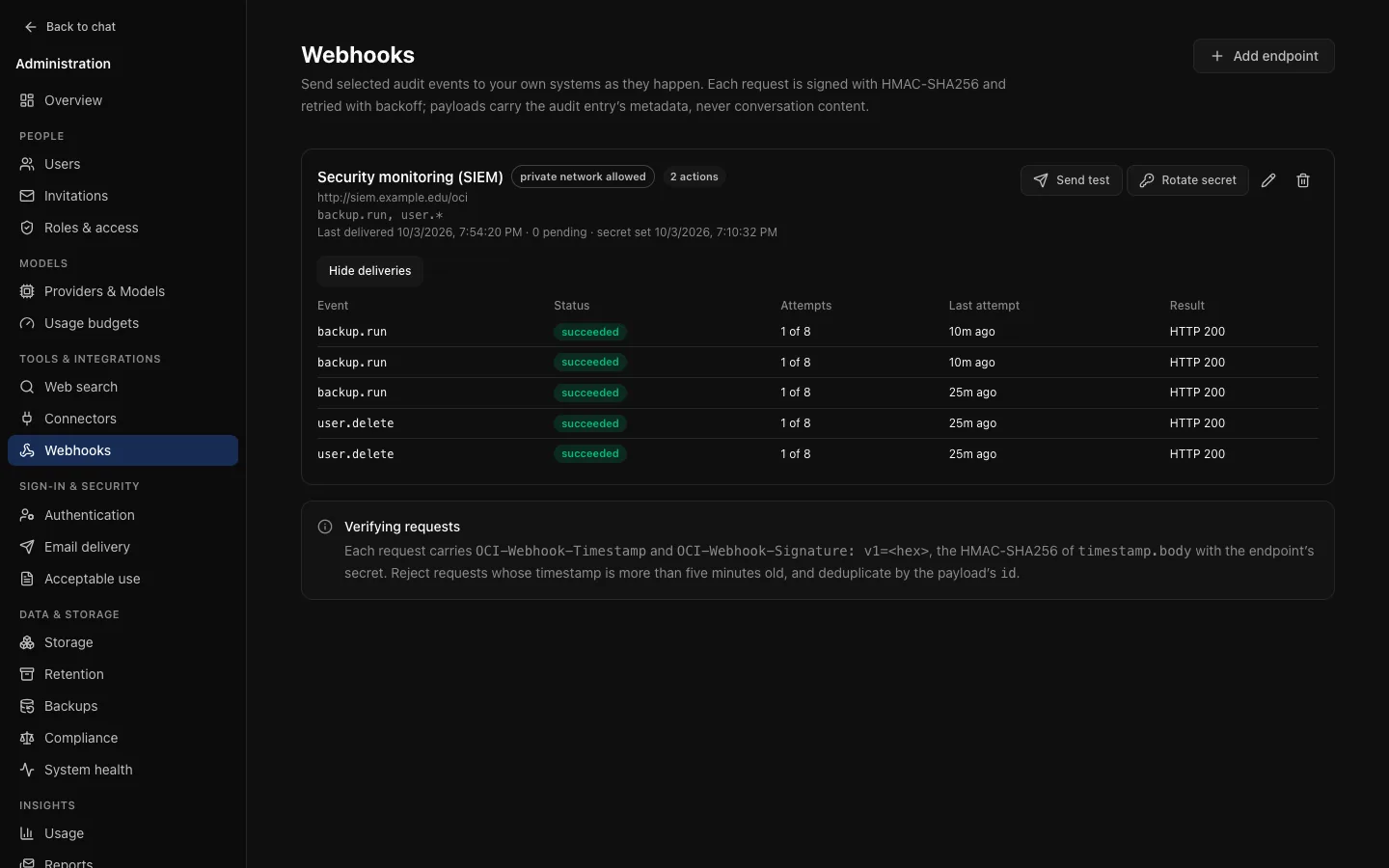
Tools & integrations → Webhooks (/admin/webhooks). An endpoint receives the audit events you choose as they are recorded: user.* to follow account changes, or backup.run to alert on a failed backup.
Adding an endpoint
Add endpoint, then:
- URL: an
https://address. Redirects are not followed. - Audit actions, one per line:
user.creatematches exactly;user.*matches every action startinguser.. Or Send every audit event, which includes onetool.callper tool call. - Allow private network: as for connectors, endpoints must be public HTTPS addresses unless this is on. Cloud metadata addresses are always refused.
Saving shows the endpoint's signing secret once; OCI stores it encrypted. Rotate secret replaces it and shows the new one once. Send test posts a signed webhook.test event and shows the answer. Show deliveries lists the last 50 with status, attempts and last error. Endpoint changes are audited (webhook.create, webhook.update, webhook.rotate, webhook.delete) and kept regardless of retention.
What is sent
A POST with a JSON body:
{
  "id": "6f0c1d2e-…",
  "type": "user.role.change",
  "createdAt": "2026-10-02T09:14:03.120Z",
  "actor": { "id": "u_123", "email": "morgan.lee@example.edu" },
  "target": { "type": "user", "id": "u_456" },
  "metadata": { "from": "user", "to": "auditor" }
}
id is the audit entry's ID, the same on every retry: deduplicate on it. The IP address is left out. Headers: OCI-Webhook-Id, OCI-Webhook-Event, OCI-Webhook-Timestamp (Unix seconds) and OCI-Webhook-Signature: v1= and the hex HMAC-SHA256 of <timestamp>.<body> keyed with the secret.
Verifying a request
Compute the HMAC-SHA256 of the timestamp header, a full stop and the raw body, keyed with the secret (including its whsec_ prefix); compare in constant time; reject timestamps more than five minutes from your clock.
import { createHmac, timingSafeEqual } from 'node:crypto';

export function verifyOciWebhook(secret, headers, rawBody) {
  const timestamp = headers['oci-webhook-timestamp'];
  const signature = headers['oci-webhook-signature'] ?? '';
  if (Math.abs(Date.now() / 1000 - Number(timestamp)) > 300) return false;
  const expected = Buffer.from(
    `v1=${createHmac('sha256', secret).update(`${timestamp}.${rawBody}`).digest('hex')}`,
  );
  return signature
    .split(',')
    .map((value) => Buffer.from(value.trim()))
    .some((value) => value.length === expected.length && timingSafeEqual(value, expected));
}
Answer with any 2xx within ten seconds.
Delivery and retries
Events are queued in the database with the audit entry and sent by a background job within about a second; delivery is at least once.
| Outcome | What happens |
|---|---|
2xx | Delivered. |
| Another status, a timeout (10 s) or a connection error | Retried after 1, 2, 4, 8, 16, 32 and 60 minutes; after 8 attempts, failed. |
| Refused address, scheme or redirect | Failed at once. |
| Endpoint disabled or deleted | Pending deliveries are dropped. |
The last failure shows on the endpoint and in System health, which also warns when deliveries are more than 15 minutes overdue. Finished deliveries are kept for 30 days.