Embeddings and reranking
Optional meaning-based search and reranking for large project files, what they need, what they cost, and how they fail safely.
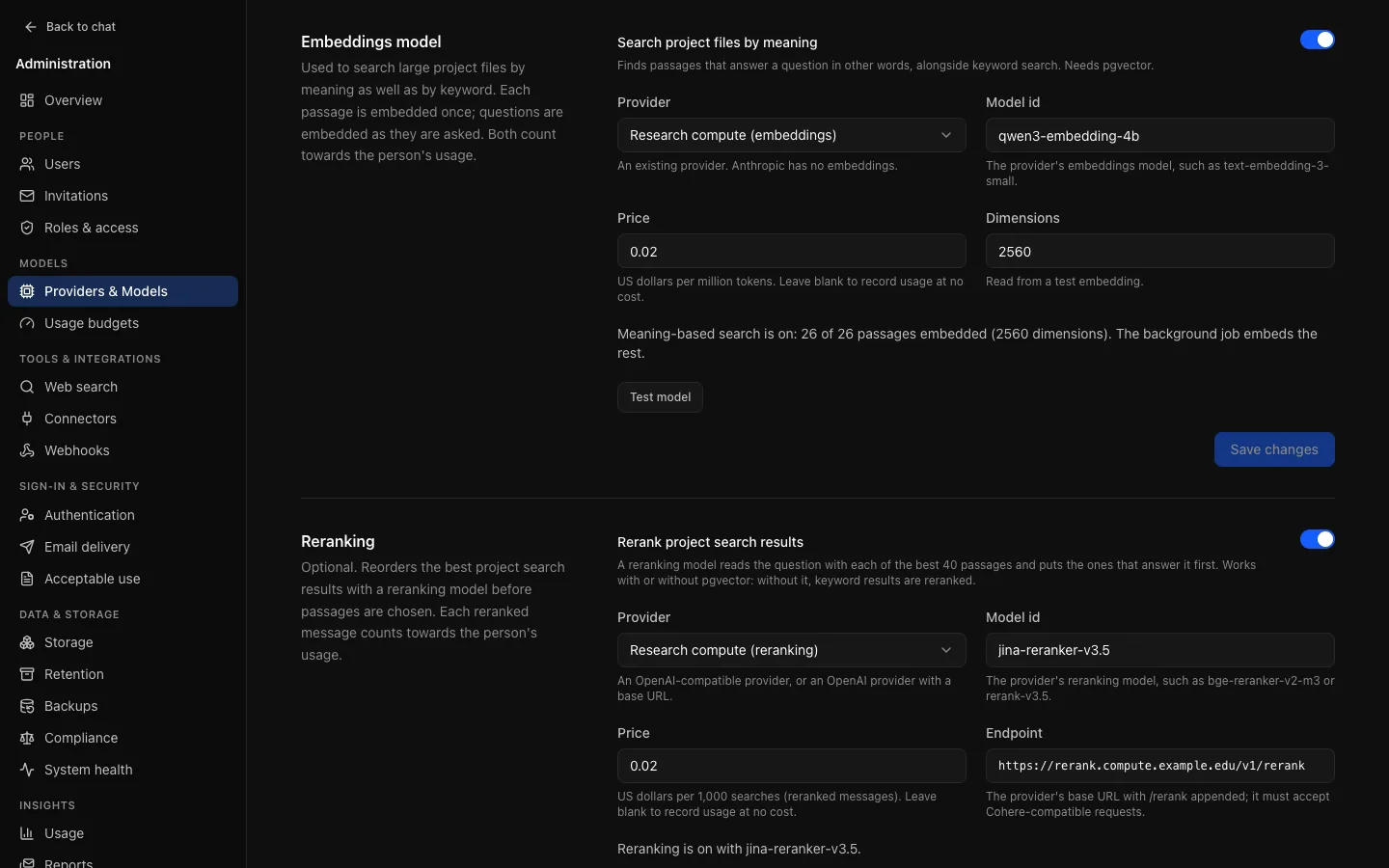
When a project's files are too large to give a model whole, OCI searches them for the passages that matter, by keyword. Two optional stages improve that search. Both are on the Embeddings tab of Models → Providers & Models (/admin/models?tab=embeddings).
| Stage | What it adds | Needs |
|---|---|---|
| Keyword search | Always on | Nothing |
| Meaning-based search (embeddings) | Finds passages that answer a question in other words, merged with the keyword results | pgvector in PostgreSQL, and an embeddings model |
| Reranking | A reranking model reads the question with the 40 best candidates and puts the ones that answer it first | A Cohere-compatible /rerank endpoint; works with or without pgvector |
Meaning-based search
Each passage is turned into a vector (an embedding) once, and each question as it is asked. The passages closest in meaning are merged with the keyword results (reciprocal rank fusion), so exact names and codes still rank first.
It needs two things:
- pgvector in the database. The tab shows whether the extension is not installed on the server, installed but not enabled, or enabled. OCI never enables it itself: an operator runs
CREATE EXTENSION IF NOT EXISTS vector;once. See Upgrades → pgvector. - An embeddings model. Choose an existing provider (OpenAI, Google or OpenAI-compatible; Anthropic has no embeddings) and enter the model ID, such as
text-embedding-3-smallor, on a local server,nomic-embed-text. Test model embeds a sample and reports the vector size. A model that cannot embed the sample cannot be switched on.
Once both are in place, OCI creates its embeddings table and a background job (projects.embed-passages) embeds existing passages, a batch every five minutes; new uploads embed their opening passages straight away. The tab shows how many passages are embedded and any files waiting to be retried. System health has a Meaning-based search row with the same.
- Relevance floor. Passages with a cosine similarity below 0.2 to the question are left out. With OpenAI's
text-embedding-3or Cohere's embed-v3, unrelated text scores below that; with models such asnomic-embed-textorbge-m3it scores above 0.3, so the floor removes little and keyword search and reranking do the filtering. - Changing the model re-embeds everything in the background; until a project is done, its searches are keyword-only. Switching it off keeps the stored embeddings.
- Cost. Calls are usage under
embedding:<model id>: passages are charged to the file's owner, questions to the person asking. They count tokens (and cost, if you set a price per million tokens), no messages, and count towards budgets that cover every model. - Failures. A failed or slow embeddings call never fails a reply: it is searched by keyword instead, and the failure is logged.
Reranking
Choose an existing provider and the reranking model ID, such as bge-reranker-v2-m3, jina-reranker-v2-base-multilingual or rerank-v3.5. Test reranking reranks a three-sentence sample and reports how long it took; a model that cannot rerank it cannot be switched on.
OCI calls the Cohere-compatible API at the provider's base URL with /rerank appended (https://host/v1 becomes https://host/v1/rerank); the section shows the resolved URL. Only OpenAI-compatible providers, and OpenAI providers with a base URL, are offered.
| Server | Base URL | Notes |
|---|---|---|
| LiteLLM | https://litellm.example.edu/v1 | Its /rerank route forwards to Cohere, Jina, Hugging Face TEI, vLLM and others. |
| vLLM | http://vllm:8000/v1 | Serve a cross-encoder, such as vllm serve BAAI/bge-reranker-v2-m3. |
| Hugging Face TEI | Through LiteLLM | TEI's own /rerank expects texts rather than documents. |
| Jina | https://api.jina.ai/v1 | jina-reranker-v2-base-multilingual. |
| Cohere | https://api.cohere.com/v2 | rerank-v3.5, added as an OpenAI-compatible provider. |
- Relevance floor. Passages scored below 0.05 (on a 0–1 scale) are left out with everything after them; if none passes, no project passages are used. Servers that return raw scores outside 0–1 only reorder.
- Time limit. A reply waits at most five seconds. A timeout or error keeps the previous order, is logged, and never fails the reply.
- Cost. Each reranked message is one usage event under
rerank:<model id>, with no message counted. It costs nothing unless you set a price per 1,000 searches.
Audit
Changes are audited as embeddings.update and reranking.update (with the previous and new setting), and tests as embeddings.test and reranking.test. Auditors can see the tab, including the resolved endpoint, but not change it.